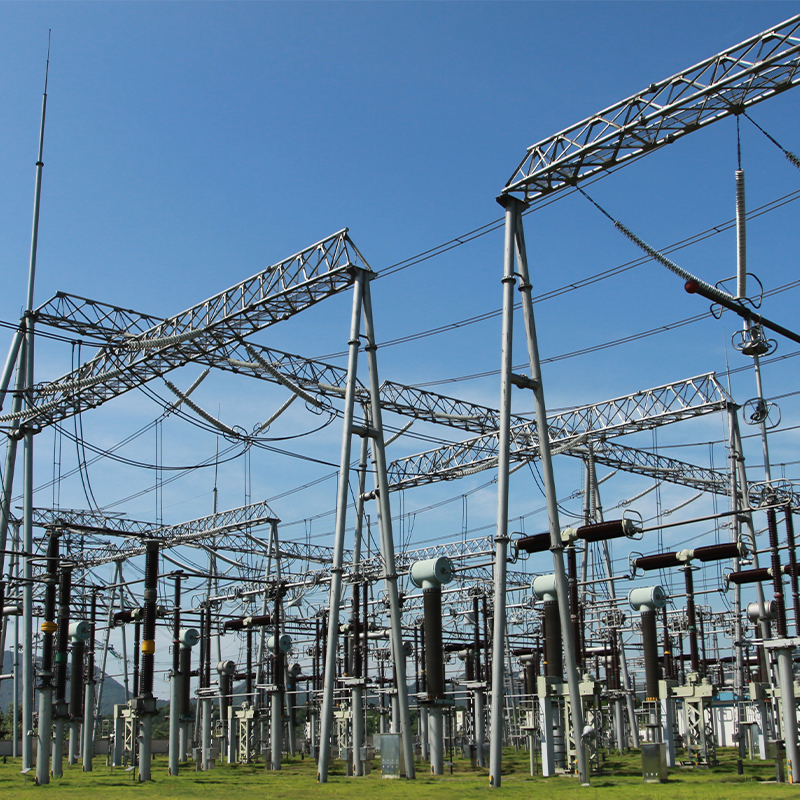
Substation steel structure
The supplier hasn’t listed a price. We can get their current prices and MOQ.
- Service
- From $29 per supplier (Verify)
- You get
- Phone and video verification, a quote sheet and a written report
- Turnaround
- 3 business days
- Contact details
- Sent to you once your request is confirmed
If we can't reach the supplier within 3 business days, we refund the fee.
Substation steel structure
The supplier hasn’t listed a price. We can get their current prices and MOQ.
- Service
- From $29 per supplier (Verify)
- You get
- Phone and video verification, a quote sheet and a written report
- Turnaround
- 3 business days
- Contact details
- Sent to you once your request is confirmed
If we can't reach the supplier within 3 business days, we refund the fee.
About this product
- Size: Non-Standard
- Color: silver
- Grade: Other
- Application: Other
- Exports to: Mainland China, Africa, Middle East, Southeast Asia, South Asia, Central Asia, Latin America, Russia, EU, Other European Countries, Japan and South Korea, Hong Kong China, Macao China and Taiwan China, Others
About this product
- Size: Non-Standard
- Color: silver
- Grade: Other
- Application: Other
- Exports to: Mainland China, Africa, Middle East, Southeast Asia, South Asia, Central Asia, Latin America, Russia, EU, Other European Countries, Japan and South Korea, Hong Kong China, Macao China and Taiwan China, Others
Product details
| Size | Non-Standard |
|---|---|
| Color | silver |
| Grade | Other |
| Application | Other |
From the supplier
Introduction to Substation Gantries & Structures
I. What are Substation Structures?
Substation structures, also known as gantries or support structures, are steel or reinforced concrete frameworks within a substation used for fixing, supporting, and suspending various electrical equipment and busbars (conductors). While their function is similar to transmission towers, their application and design differ significantly:
-
Application: Used exclusively inside a substation.
-
Core Function: To ensure sufficient safe clearances between live parts (e.g., busbars, connecting wires) and between live parts and the ground; to provide a stable platform for the installation, operation, and maintenance of equipment.
II. Main Functions of Substation Structures
-
Support Conductors (Busbars): Suspend and support connecting conductors (either flexible busbars or rigid tubular busbars) between main transformers, circuit breakers, and disconnect switches.
-
Mount Electrical Equipment: Provide the mounting base for equipment such as disconnect switches, voltage transformers, current transformers, surge arresters, and coupling capacitors.
-
Ensure Safe Clearances: Maintain specified safety clearances between live parts at different voltage levels and between live parts and grounded structures to prevent electrical flashover.
-
Withstand External Loads: Bear conductor tension, equipment weight, wind load, ice load, seismic load, and additional loads during construction and maintenance.
III. Classification of Substation Structures
1. By Structural Material-
Steel Structures:
-
Characteristics: The most common type today. Typically made from hot-dip galvanized angle steel, steel tubes, or fabricated steel pipe members.
-
Advantages: High strength, light weight, easy installation, short construction period, aesthetically pleasing.
-
Types: Can be divided into angle steel structures and steel tube structures (including steel poles and fabricated steel pipe structures). The latter is more aesthetically pleasing and offers better wind resistance, making it widely used in modern substations.
-
-
Line Entrance/Exit Gantries:
-
Location: At the boundary of the substation, serving as the "gate" for transmission lines entering or leaving.
-
Function: Support the conductors entering/exiting the substation and suspend equipment like line traps and Capacitive Voltage Transformers (CVTs). Often among the tallest and most heavily loaded structures in a substation.
-
-
Busbar Structures:
-
Location: The central area of the substation, connecting various bays.
-
Function: Support and suspend the busbars at different voltage levels, forming the core structure for power collection and distribution.
-
-
Equipment Supports/Pedestals:
-
Location: Scattered throughout the substation.
-
Function: Specifically designed to support heavy or height-specific equipment such as circuit breakers, disconnect switches, current/voltage transformers, and surge arresters. They are usually shorter but require high stability.
-
IV. Main Components of Substation Structures
Similar to transmission towers but focusing more on a "beam-column" system:
-
Column: The vertical supporting element of the structure, which can be A-frame, portal-type, etc.
-
Beam (Crossbeam): The horizontal structure mounted on top of the columns, used for suspending insulator strings and conductors. Common forms include triangular truss beams and rectangular cross-section beams.
-
Foundation: The part anchoring the structure to the ground, bearing all the loads from above. The quality of the foundation directly determines the structure's stability and safety.
-
Ladders and Platforms: Facilities for operators and maintenance personnel to access the structures and perform work.
-
Grounding Down Conductors: Conductors that divert lightning current or fault current from the structure into the grounding grid.
About the supplier
- ✓Exhibited at 2 recent Canton Fairs
- ✓Industry and Trade Company
- ✓Founded 2009
- ✓Canton Fair Premium Supplier
- ✓National high-tech enterprise
- Exhibited at 2 recent Canton Fairs
- Industry and Trade Company
- Founded 2009
- Canton Fair Premium Supplier
Similar products from other suppliers
Add a few to compare, then request quotes from all of them at once.